Destinations / Costa del Sol

Nerja

A town of about 22,000 at the eastern end of the Costa del Sol, with coves under the cliff and mountains close enough to walk into.

Some links are partner links, marked Partner. They never change what we write. How we earn

6
good months a year
23°
day air in the good months
18°est.
sea in the good months
8
hours of sun a day in the good months
60%est.
hotels full in the good months

Nerja: a balcony over the sea, a cave beneath it, a river to wade

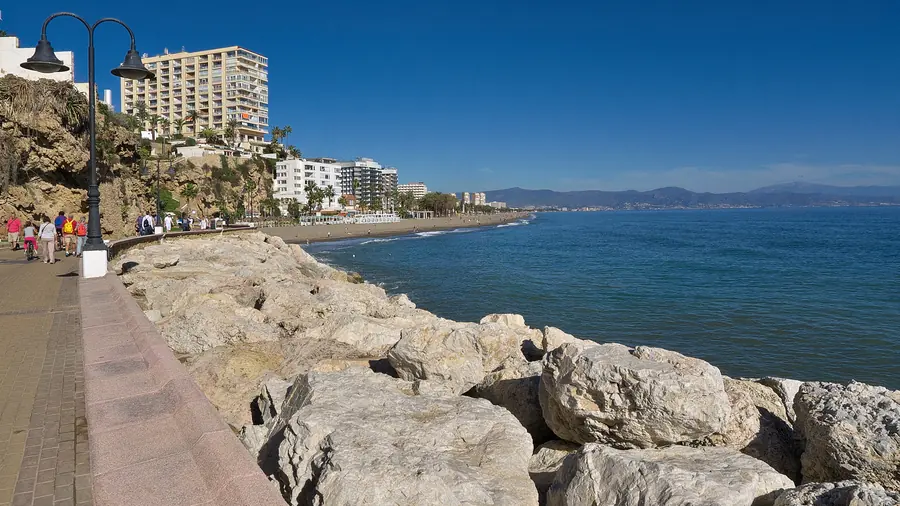
Stand on the Balcón de Europa first thing and the town lays itself out for you. The promenade runs onto a headland in the old town, cafés at your back, the sea ahead. Look down and there are coves tucked under the rock: Calahonda beside it, La Caletilla, about 50 m long and narrower when the sea is up, and the three small coves of El Chorrillo, all reached through an opening in the wall. Turn round and the old town is narrow lanes, whitewashed houses and iron balconies with geraniums. Nerja was a fishing village before it was a resort, and the lanes have not forgotten it.

The town has about 22,000 residents and sits 50 km east of Málaga. Tourism has paid the bills since 1960, when the cave opened to the public, yet the centre still works on foot, as long as you accept the hills. Think of Nerja in three layers: the town and its coves; Maro, a village about 4 km away that holds the cave and lies inside a natural park; and behind everything the Sierras of Tejeda and Almijara, topped by La Maroma at about 2,080 m.

Give the mornings to the things that need cool air or still water. The Cueva de Nerja is three known galleries, of which you see one: a ten-minute film, then about 45 minutes with an audio guide past stalactites, columns and spirals. Its 589 rock paintings stay closed to protect them. The Río Chillar is the other morning job. You walk up the riverbed itself into Los Cahorros, where the gorge narrows to three cracks just over a metre wide between walls more than 20 m high. The water is usually at your ankles, at your knees in some years. And if you snorkel, go early, before the westerly wind lifts the waves.

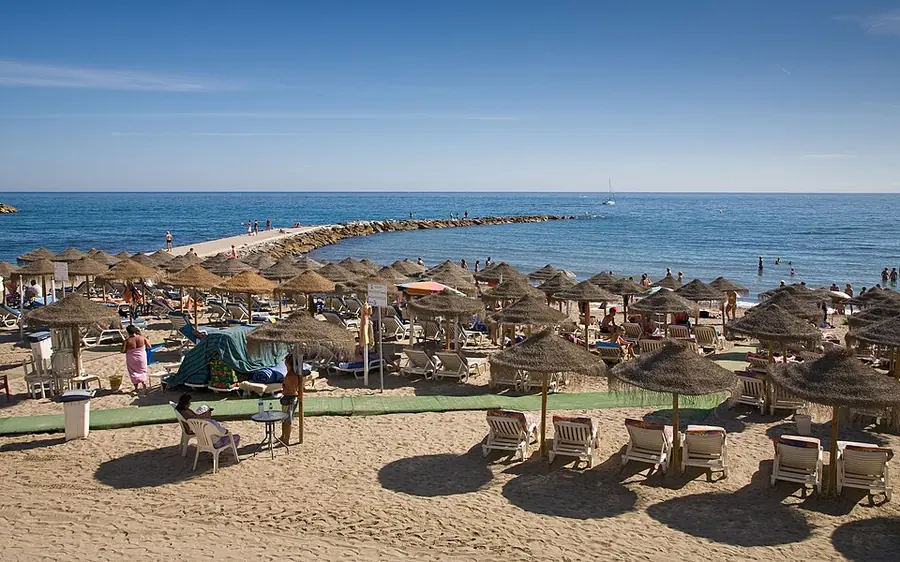
Midday belongs to the beach. Burriana is the busy one, with the most services and water sports, and its beach bars feed you: wood-fired paella with refills at Ayo, sardines and squid off the grill at La Barca. El Playazo runs about 2 km, has parking and draws families, and its western end is the quieter stretch. Evenings are for tapas. At El Pulguilla and Taberna Pepe Moles a small plate comes with the drink, and in summer ajoblanco, the chilled almond and garlic soup, arrives here with grapes.

Nerja suits people who want to swim and walk from the same base. Our mapped data counts 45 beaches within 15 km and 37 walking routes within 25 km, 11 of them easy. Snorkellers get the Maro coves, inside a protected area of about 1,913 ha, mostly sea. Think twice if you want to arrive by rail: there is no airport, no train and no boat. Málaga airport is about 45 minutes by car on the A-7, or you take a bus via Málaga. Think twice, too, if you hate crowds in high summer, when hotels are about 77 to 82 percent full (est.) and the afternoons reach 30 to 31°.

The good months are March to June and October to November. May gives 24° days and a sea of about 18.5° (est.); October 25° days and a sea near 20° (est.), with about 61 mm of rain. Swimmers should know the sea is about 16° in March and April (est.) and only reaches 23 to 25° in July and August (est.). The town's calendar runs from San Juan in late June, with bonfires on the beach, to the Virgen del Carmen procession and sea outing in mid-July and the fair in October. Dates shift a little from year to year, so check before you plan around them.

Tips

  1. Wear shoes for the Chillar that can get wet and cover the ankle. Flip-flops and mountain boots are both the wrong choice, and the rocks are slippery after heavy rain.

  2. Check before going

    The official Chillar page has carried an old closure notice, so confirm the walk is open. The Almijara (market) car park, the usual start, has been closed on Tuesdays, when the Mirto Street car park is the alternative.

  3. Check before going

    The cave has usually opened 9:00 to 15:30, with longer hours in July, August and part of Holy Week, and has closed on 1 January and 15 May.

  4. Snorkel early. The sea is calmest before the westerly gets up, and strong easterlies cloud the water.

  5. For the coves under the Balcón, look for the opening in the wall.

  6. Check before going

    Parking at Maro is limited, and in summer private cars have been restricted with a shuttle running instead. At La Caleta de Maro the car park fills as the day goes on.

Sources: 10 checked claims from 25 sources. All sources

Good months

Good months: March, April, May, June, October and November

The quiz weighs warmth, sun, sea and crowds your way.

Facts for March

March: 19° days, sea 16° (est.), 7.1 hours of sun, moderate (hotels about 51% full, est.), and one of the wetter months (67 mm).

Month by month

Month by month figures
MonthAir °CSea °CEST.Sun hCrowd %EST.Verdict
Jan1816638Fine18° by day
Feb1816648Fine18° by day
Mar1916751Go in19° by day
Apr2117857Go inmild: 21°
May24191066Go inmild: 24°
Jun28201171Go inmild: 28°
Jul30231277Finebusy: 77% occupancy
Aug31251182Think twicebusy: 82% occupancy
Sep2823973Finesea 23°
Oct2520768Go inmild: 25°
Nov2117647Go inmild: 21°
Dec1916533Fine19° by day

Verdict from our neutral month score, the same for everyone. Never changed by partners.

Sources: AEMET 1991-2020 monthly averages; NOAA OISST sea-temperature averages 2019-2024 (estimate, about 25 km grid); estimate from visitor numbers (INE).

Go if

  • You can go in March to June and October to November: days of 19–28°, sea 16–20° (est.).
  • You want beaches close by: 45 mapped within 15 km, the nearest about 600 m from the centre.
  • You like walking: 37 routes within 25 km, 11 of them easy.

Think twice if

  • You dislike crowds in July or August: hotels 77–82% full (est.).
  • You want to swim in March, April or November: sea 16–17° (est.).
  • You need to be close to the airport: Málaga is 74 km away.

Climate: AEMET 1991–2020. Sea: NOAA OISST 2019–24, estimate. Hotels: INE 2024–25, estimate. Beaches: OpenStreetMap. Walking routes: PikaPoko.

Things to do

  • Cueva_de_Nerja_2020 · Fernando, CC BY-SA 4.0 · Wikimedia Commons

    Cueva de Nerja

    Local young people found the caves on 12 January 1959 while looking for bats. You see one gallery of stalactites, columns and spirals; the 589 known rock paintings are off limits.

    When Any month, morning; check opening hours before going

  • Aquaduct_Nerja_(7007988881) · michael clarke stuff, CC BY-SA 2.0 · Wikimedia Commons

    Church, hermitage and aqueduct

    The 17th-century Iglesia de El Salvador stands near the Balcón and the 16th-century Ermita de las Angustias is also in the old town. The 19th-century Águila aqueduct is on the way to the caves, and the town has a history museum.

    When Any time

  1. Balcón de Europa and the old town

    Walk out onto the headland for the sea view, then back into lanes of whitewashed houses and iron balconies. Calahonda and La Caletilla lie directly below.

    When Any month; early or late in the day

  2. Río Chillar walk

    A medium walk up the riverbed into the Los Cahorros gorge, with three cracks just over a metre wide and walls over 20 m high. No climbing needed. The official page gives about 5 km return to the first pool and 8 km each way to Vado de los Patos; other sources differ.

    When March to October, early start

  3. Snorkel the Maro coves

    The Maro coves and the rocky shallows near Burriana have salema, sea bream, octopus and posidonia meadows, in water of about 19 to 24°. Guided tours usually include the gear.

    When May to October, early morning

  4. Kayak under the Maro cliffs

    Local operators run guided kayak trips along the cliffs of Nerja, Maro and Cerro Gordo, some with a snorkelling stop, and Maro beach has kayak rental. The cliffs are part of a protected area declared in 1989, about 1,913 ha and mostly sea.

    When Check season, length, level and price with the operator

  5. A beach day at Burriana or El Playazo

    Burriana is the busiest beach, with the most services and water sports. El Playazo is the longest, about 2 km, with parking and beach restaurants, and calmer at its western end.

    When June to September; sea 23 to 25° in July and August (est.)

  6. Walk in the Sierras

    The Sierras of Tejeda and Almijara rise behind the town, with La Maroma at about 2,080 m. Routes run from easy strolls to hard climbs; our data counts 11 easy ones within 25 km.

    When Avoid midsummer: July and August highs reach 30 to 31°

  7. Follow Verano Azul

    The TV series Verano Azul aired in 1981 and 1982 and was filmed mainly in Nerja. A replica of its boat stands in the Verano Azul park, a statue of Chanquete stands on the Balcón, and Calahonda was a location.

    When Any time

Sources: 36 checked claims from 25 sources. All sources

Where it is

Map of Spain with Nerja marked in Andalucía.

Open in OpenStreetMap

Map: Natural Earth, public domain. Simplified outline.

Eat and drink

Dishes to look for

  • Ajoblanco

    A chilled summer soup of bread, garlic, crushed almonds, olive oil and salt. Nerja serves it with grapes.

  • Spoon dishes

    Almond soup, fennel stew, cabbage stew, puchero and maimones with grapes.

  • Migas

    Fried breadcrumbs, found on local menus.

  • Fish from the coast

    Look for sardine skewers, boquerones en escabeche, fish in brine, red mullet and pescaíto frito.

  • Kid

    Young goat, cooked several ways.

  • Sweet potato and cane honey

    Sweet potato compote with honey is the local sweet. In nearby Frigiliana, a factory in the Palacio de los Condes is described as Europe's only working sugar cane honey producer.

Places the sources name

  • Ayo (Burriana)

    Known for Wood-fired paella with refills, and a link to Verano Azul.

  • La Barca (Burriana)

    Known for Fish and meat over the barbecue, including squid and sardines.

  • El Pulguilla

    Known for Fried fish and seafood, with tapas served with drinks. Very busy at weekends and in summer.

  • Taberna Pepe Moles

    Known for Tapas with drinks: croquettes, cod-stuffed peppers and pork secreto.

  • Redondo Bar

    Known for A round bar with the staff inside the ring, and fried camembert.

  • Dolores El Chispa

    Known for Traditional Málaga food and local products.

  • Oliva

    Known for Modern, creative Mediterranean cooking.

  • Carabeo 34

    Known for A hotel restaurant: steak, leg of lamb and a terrace over the sea.

A list of named places, not a ranking.

Sources: 17 checked claims from 25 sources. All sources

Eat and do

The centre has 34 restaurants within about 400 m. To see: Caves of Nerja, Águila Aqueduct and El Salvador Church.

Places to eat

Show the area on a map
Source: OpenStreetMap contributors, ODbL, fetched 2026-11-07

Local food first: tapas, seafood and regional dishes, picked from the travel guide and from restaurants mapped with a local cuisine tag.

Not a ranking. Places come from the Wikivoyage guide and OpenStreetMap cuisine tags, near the centre. Check opening hours before you go.

Sights and things to do

Landmarks and places to visit, each with the opening lines of its encyclopedia article.

  • Cueva_de_Nerja_2020 · Fernando, CC BY-SA 4.0 · Wikimedia Commons
    SeeCaves of NerjaThe Caves of Nerja are a series of caverns close to the town of Nerja in the Province of Málaga, Spain. Stretching for almost 5 kilometres, the caverns are one of Spain's major tourist attractions.Source: Wikipedia, CC BY-SA 4.0, fetched 2026-11-07
  • Aquaduct_Nerja_(7007988881) · michael clarke stuff, CC BY-SA 2.0 · Wikimedia Commons
    SeeÁguila AqueductThe Águila Aqueduct (Spanish: Acueducto del Águila is a 19th-century civil engineering project located in the municipality of Nerja, in Andalucía.Source: Wikipedia, CC BY-SA 4.0, fetched 2026-11-07
  • SeeEl Salvador ChurchNear the Balcony of Europe, facing the plaza just around the corner from the Balcony, is this attractive 17th-century church constructed in baroque-mudejar style.Source: Wikivoyage, CC BY-SA 3.0, fetched 2026-11-07
  • SeeCalahonda BeachA pebbly beach in the cliffs below the Balcony of Europe, with lots of little crags and crannies.Source: Wikivoyage, CC BY-SA 3.0, fetched 2026-11-07
  • SeeCarabeo BeachAnother pebbly beach perched in a scenic alcove accessed by a steep stairway.Source: Wikivoyage, CC BY-SA 3.0, fetched 2026-11-07
  • SeeCarabeillo BeachA sandier beach tucked under a cliff that marks the western end of the Burriana Beach.Source: Wikivoyage, CC BY-SA 3.0, fetched 2026-11-07

Sights named in the Wikivoyage guide, ordered by English Wikipedia article views over 12 months. This is attention, not quality.

Day trips

  • Frigiliana

    A white village with a Moorish quarter of steep cobbled lanes. Twelve ceramic panels from 1982 tell the story of the Morisco rebellion.

    About 6 km north (Wikivoyage says 8 km).

  • Granada and the Alhambra

    A palace and fortress complex, a World Heritage Site since 1984, with the Nasrid Palaces, the Alcazaba and the Generalife gardens.

    About 105 km, so a long day. Check opening and tickets before you go.

    See Granada
  • Málaga

    Picasso's birthplace, with an 11th-century Alcazaba, a Roman theatre from the 1st century BC and the Museo Picasso Málaga, opened in 2003.

    About 50 km west; buses run non-stop from Nerja.

    See Málaga
  • Almuñécar

    Founded as the Phoenician colony Sexi around 800 BC, with the San Miguel castle and Roman remains that now house the town museum. Mangoes, avocados and cherimoyas grow in its warm climate.

    Borders Nerja, over the line in Granada province.

    See Almuñécar
  • Caminito del Rey

    A walkway about 2.9 km long and 1 m wide, more than 100 m above the river in the El Chorro gorge near Ardales, reopened in 2015.

    We have no sourced distance or travel time. Check access rules before you plan.

Sources: 13 checked claims from 25 sources. All sources

Getting there

Practical

  • Fly to Málaga. It has direct flights from Stockholm, Gothenburg, Copenhagen, Oslo and Helsinki; airlines change by season, so check. Nerja has no airport, train station or boat service.
  • From Málaga airport it is about 45 minutes by car on the A-7.
  • Buses run non-stop from Málaga to Nerja and stop on Avenida de Pescia. Nerja also has buses to Granada, Almería and Motril but is outside the Málaga metropolitan transport system. Check fares and times with the operator.
  • In town you walk, and the town is hilly. With a car, use the central car parks.
  • Check before goingMarkets have been held on Sunday (flea market), Tuesday (Chaparil) and Thursday (flea market).

Sources: 8 checked claims from 25 sources. All sources

Routes that ran last year (Eurostat), not a timetable. Flight times are estimates. Flights: Eurostat 2024.

Not sure this is the one?

See places that fit your month.

Help me choose

More in Costa del Sol

Hiking routes in Spain: Pikapoko