Marbella: orange trees, old walls and a long seafront
Start in the Plaza de los Naranjos, where a Renaissance fountain stands among orange trees planted in 1941. The square itself is older. It was laid out in 1485, the year Marbella surrendered to the Catholic Monarchs on 11 June. White Andalusian houses close it in, with the town hall, the Casa del Corregidor and the Ermita de Santiago, believed to date from the 15th century and described as the town's oldest religious building.
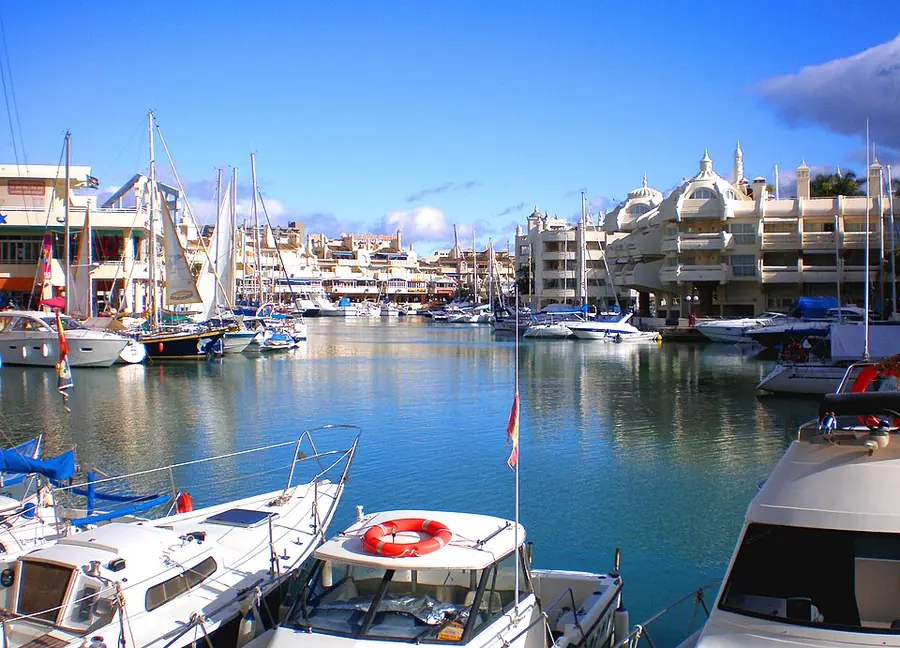
Marbella is a municipality of 159,786 people on the Costa del Sol, between Málaga and the Strait of Gibraltar. Phoenician and Punic peoples settled in the Río Real area around the 7th century BC, and in the Islamic period Marbella became a walled town with a castle. Until the 1950s it was an agricultural town that took in summer visitors; tourism from the 1960s changed that. Think of it in three parts. The old town is narrow streets with Andalusian and Moorish architecture. The Golden Mile is a stretch of about 6.4 km of villas and hotels, running from the western edge of town towards Puerto Banús. And Puerto Banús, about 6 km south-west, is a marina and shopping complex from 1970, where the architects proposed a low-rise Andalusian-village look instead of tall blocks.
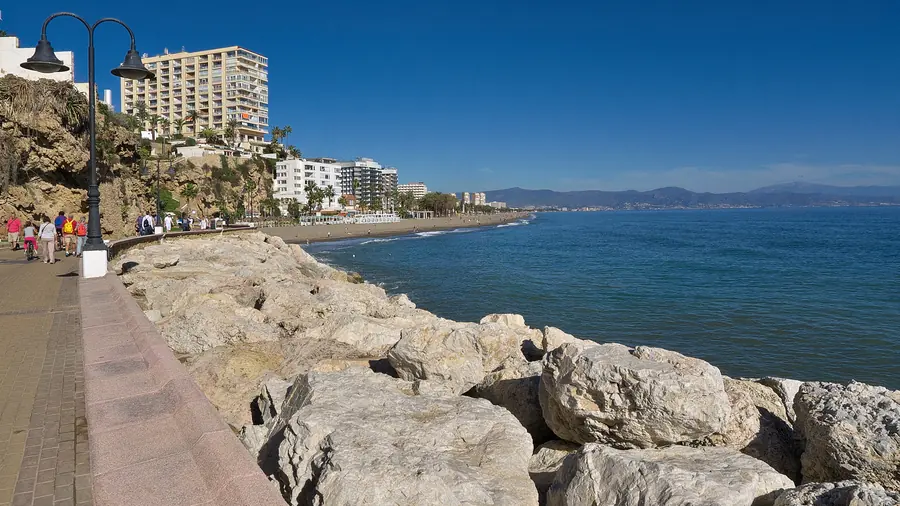
The centre is compact, so the old town is a morning on foot. Then take Avenida del Mar, a pedestrian street lined with sculptures, down to the beach. The Paseo Marítimo runs about 6 km along the seafront, past sand beaches such as La Bajadilla and La Fontanilla. Lunch is fish: fried anchovies, mackerel, mullet and squid, or espetos, which some seafront restaurants grill in sand-filled boats along the promenade. In the evening Puerto Banús takes over, with boutiques, restaurants, bars and nightclubs around the marina and a sand beach on each side.
Marbella suits you if you want a beach, an old town and mountains from one base. Our map data counts 27 beaches within 15 km and 44 walking routes within 25 km, 23 of them easy, and the Sierra Blanca rises behind the town, with La Concha at 1,215 m. Think twice if cost matters: Puerto Banús is not cheap. Think twice if you dislike crowds: hotel beds are about 70% full in August (est.), and holiday rentals are dense, at about 24 places per 100 residents (est.). And think twice if you want to arrive by train. Marbella has no station; the nearest is Fuengirola, 27 km away, and Málaga airport is about 50 km by road (est.).
Rain comes to about 540 mm a year. November (93 mm) and December (92 mm) are the wettest months, while June, July and August get 1 mm or less each. July has about 11 hours of sun a day, December about 5. The sea takes its time. It is about 15.6 degrees in February and March and 17.8 in May, and reaches about 22.9 in August (est.). For a swim without the August crowds, look at June and September: 1 mm and 23 mm of rain, a sea of about 19.0 and 21.8 degrees (est.), and hotels about 63% and 59% full (est.). In winter they empty: about 28% in December (est.).