Benalmádena: a village on the hill, a town in the middle, a marina by the sea
Stand at the fountain in Plaza de España, up in Benalmádena Pueblo, where a bronze girl offers water in a shell: La niña de Benalmádena. The village sits 241 m above sea level and 2.7 km from the coast, and its street plan keeps traces of its Andalusi past. In the 11th century the population gathered here, in a walled town with a fortress. Also in the village are the Jardines del Muro, gardens of plants and water designed by César Manrique, with views of the coast. The town's oldest church, Santo Domingo de Guzmán, stands among them.
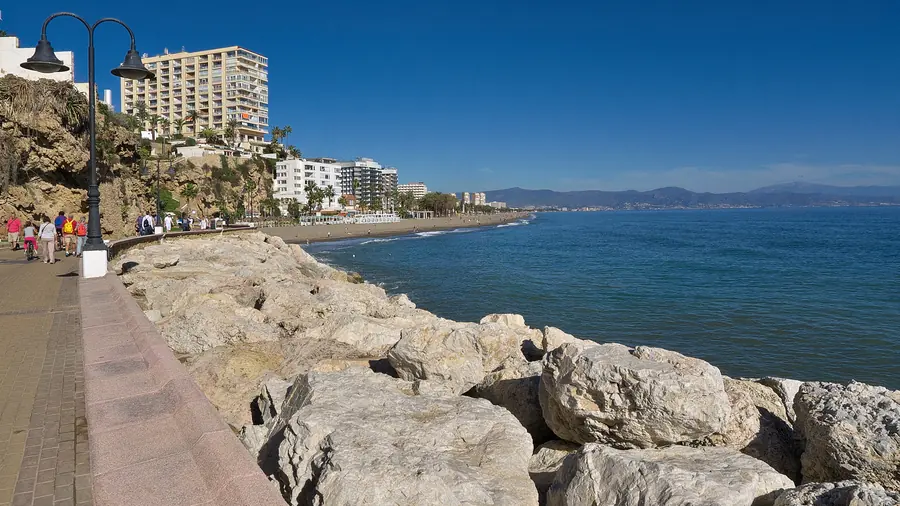
Benalmádena is a town of 78,338 people (INE, 2025) on the Costa del Sol, between Torremolinos and Fuengirola, and it comes in three parts. The Pueblo is the traditional village; the botanist and pharmacologist Ibn al-Baitar was born in Benalmádena in 1197. Arroyo de la Miel, the commercial hub that links village and coast, grew in the 18th century around paper factories, and the Tribuna building survives from that industry. Benalmádena Costa has most of the hotels, a long promenade, the marina and almost nine kilometres of beaches. The growth came with mass tourism, from the 1950s on.
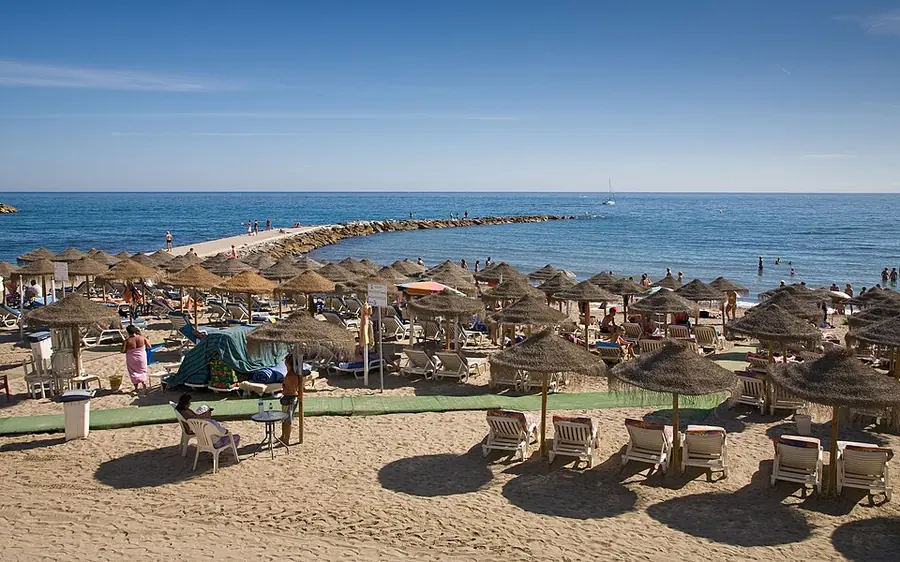
Take the village in the morning and the coast after it. Our map data names Playa Bonita, Playa de Torre Vigía and Playa del Arroyo de la Miel y los Melilleros among the beaches, and counts 42 within 15 km, a count of what is mapped, not of quality. In the evening the life moves to Puerto Marina, an open-air mall, marina and apartment complex on the water, with nightclubs next to its shopping area.
Benalmádena suits you if you want a beach holiday without a car. Málaga airport is about 14 km away by road (est.), and the Málaga to Fuengirola train line stops at Benalmádena-Arroyo de la Miel. Think twice if you are looking for one old town: the Pueblo is one of three centres, the main street of Arroyo de la Miel has British pubs, and there are 21.2 holiday-rental places per 100 residents (est.). Think twice about August, when hotel beds are about 80% full (est.). And the sea is at its coldest in March, at about 15.4 degrees (est.).
Climate figures come from the AEMET station at Fuengirola, 8 km away (normals 1991–2020). Rain adds up to about 517 mm a year: November is the wettest month at 106 mm and March gets 86 mm, while June and July record none. July has 11.4 hours of sun a day. The sea is about 18.4 degrees in May and 24.7 in August, the warmest month (est.). For swimming without the August peak, June has no rain, a sea of about 19.6 degrees and hotels about 73% full (est.), and September has 21 mm, 22.7 degrees and about 74%. October brings 64 mm of rain and a sea still near 20 degrees (est.). The town does not empty in winter: in January highs reach 15.7 degrees, the sun shines 5.9 hours a day and hotels are about 54% full (est.).