Benidorm: towers by plan, two long beaches and a cliff path
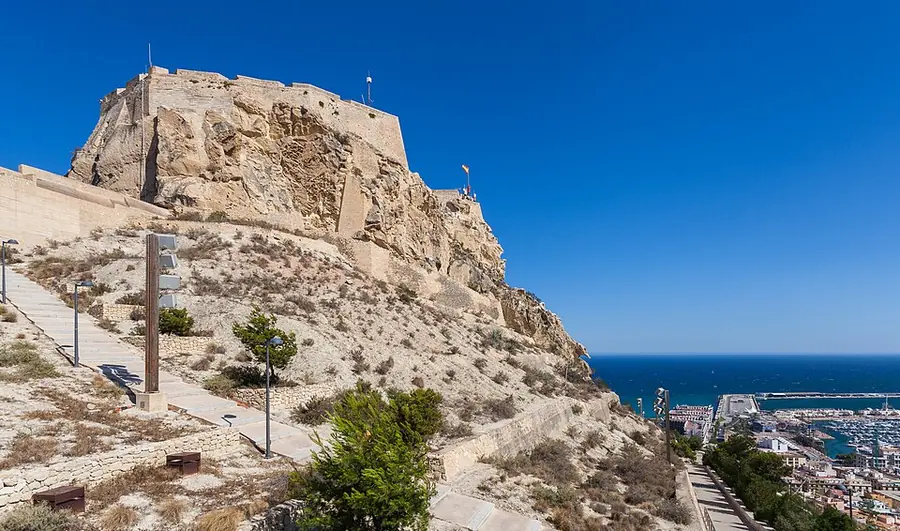
Stand at the Balcón del Mediterráneo, the viewpoint on the Cerro Canfali rock, and you have the sea in front of you. The old town sits on this promontory, between Levante beach on one side and Poniente on the other, and its church of San Jaime, from the 18th century, has blue domes. The rest of the city has been built upward. The Gran Hotel Bali, opened in 2002, has 51 floors and stands 186 m tall.
Benidorm is a mass-market resort of 77,327 residents, and it was planned as one. In the 18th century tuna fishing with the almadraba was central to the economy. Fishing declined in 1952, the town council turned to development plans built around tourism, and in the 1950s inland Spaniards, many from Madrid, began coming for the summer. The population went from 6,161 in 1960 to 68,874 in 2021, and about four in ten residents were born abroad. Growth followed structured plans, which helped avoid sprawl. The city's own case for the towers is that building upward concentrates people, gives sea views and leaves ground free for green space such as Parc de l'Aigüera and the Serra Gelada. Visitors are split about evenly between Spaniards and foreigners, and the main foreign markets are the UK, Ireland, Norway, Belgium and the Netherlands.
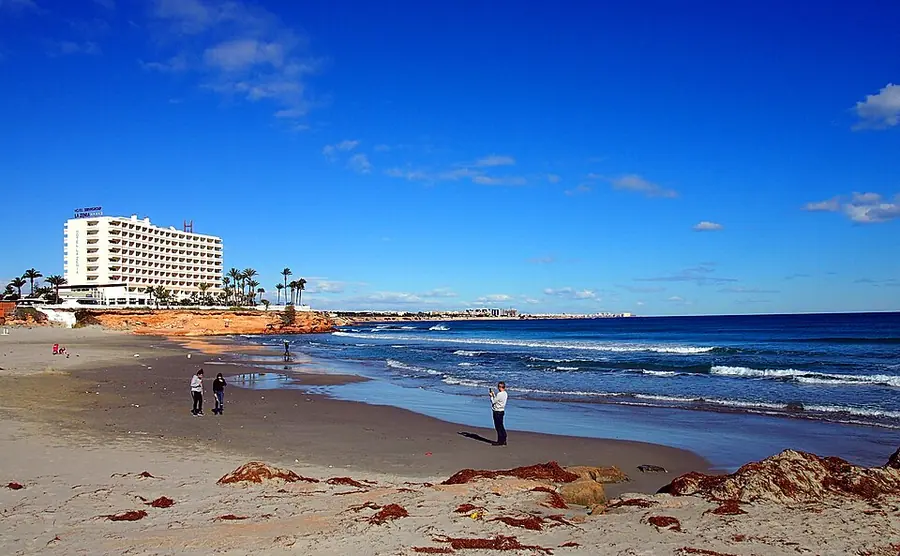
Start the day on the coves route in the Serra Gelada. It begins at the end of Levante beach, on the slope up to the Benikaktus Hotel, and runs 8.7 km, with 700 m more to and from Cala del Tio Ximo, a quiet cove near old ochre mines. It is rated easy, takes 2 to 2.5 hours and climbs at most 75 m. At Punta del Cavall a 17th-century watchtower looks over the cliffs, which rise above 300 m. Midday is for the sand. Levante, 2,000 m long, is the livelier beach; Poniente, about three kilometres, is the calmer one, and the tranquil cove of Mal Pas lies between them. In the evening go back to the old town, where the streets around Calle Santo Domingo, known as Tapas Alley or the calle de los Vascos, hold the main cluster of pintxo and tapas bars.
Benidorm suits you if you want a big, organised beach resort with plenty to fill the days. Our map data counts 34 beaches within 15 km, the town has a theme park, Terra Mítica, plus a water park and an animal park side by side, and a tram runs along the coast to Villajoyosa and Alicante. Think twice if you want a short transfer: Alicante-Elche airport is about 61 km by road (est.). Think twice if you want quiet in high summer. Hotel beds are about 79% full in July and 83% in August (est.), and those months bring large crowds of young people. And think twice if you came for mountain walks. Only 2 of the 21 mapped routes within 25 km are easy, and Puig Campana, at 1,406 m, takes 5 to 8 hours to the summit and back on a poorly marked trail.
Our climate figures come from the Alicante station, 37 km away, so read them as an approximation. Rain is scarce, about 284 mm a year, and September is the wettest month at 51 mm. The sea is slow to warm: about 15 degrees from January to March, 19.4 in May and 27.3 in August (est.). For a swim without the August peak, look at June and October, with a sea of about 22.6 and 22.9 degrees (est.), 8 and 33 mm of rain, and hotels about 78% and 72% full (est.). In winter the hotels are about half full, at 49% in January (est.), with highs near 17.4 degrees and about six hours of sun a day.